

 |
- |
|
| - |
|
| - |
|
| - |
|
| - |
|
 |
- |
|
| - |
|
| - |
|
| - |
|
| - |
|
| - |
|
| - |
|
| - |
|
 |
- |
|
| - |
|
| - |
|
 |
- |
|
| - |
|
| - |
|
| - |
|
| - |
|
| - |
|
 |
- |
|
| - |
|
 |
- |
|
| - |
|
| - |
|
 |
- |
|
| - |
|
| - |
|
| - |
|
| - |
|
| - |
|
| - |
|
| - |
|
|
|
|
 |
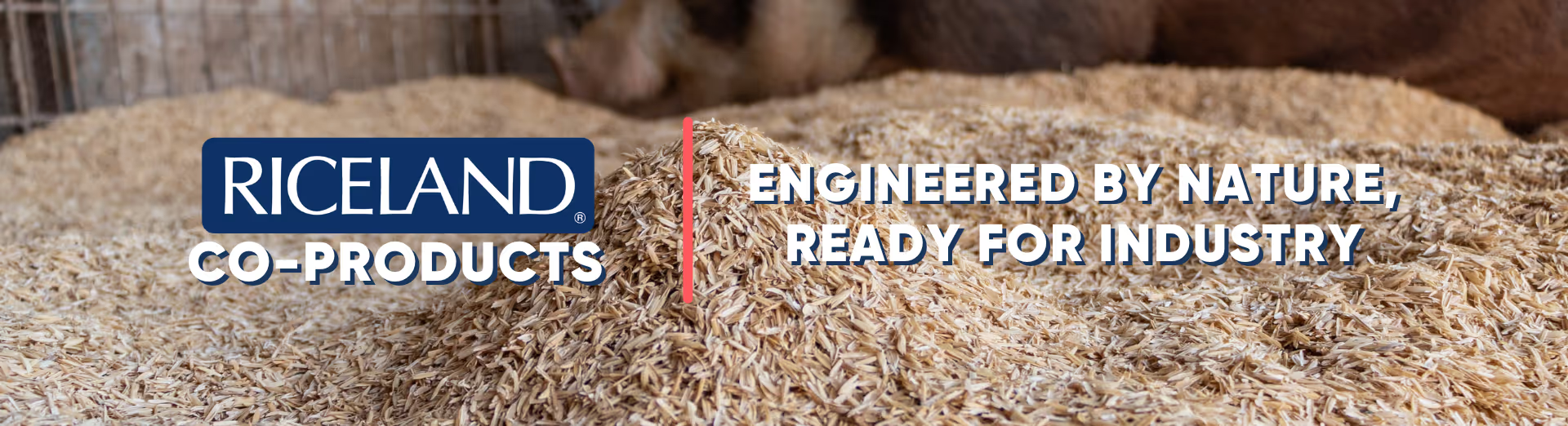
PBH Nature's Media Amendment is your number one choice for sustainable plant production and a whole lot more. This uniquely processed rice hull amendment is a readily renewable resource requiring no mining or land disruption to produce. As so many growers have learned, it is a perfect replacement for perlite in the growing media providing a less dusty mixing environment, lower basic cost and decomposition over time, while remaining stable during the typical plant production cycle.
Extremely lightweight and highly compressed when packaged in your choice of standard or bulk bale, PBH generates less waste and reduces storage requirements, handling and freight. Its physical size, shape and bulking properties produce optimum air-filled pore space, water-holding capacity and drainage, while its natural color blends with other media components. Uniquely processed to ensure purity, PBH Nature's Media Amendment is sized, cleaned and subjected to a series of heat treatments that collectively sterilize the rice hulls and render any residual rice kernels, weed seeds or disease pathogens non-viable. Greenhouse-proven PBH Nature's Media Amendment offers environmental, horticultural and economical advantages. Growers who rely on it gain sustainability, reduce input costs and sacrifice nothing in terms of plant quality.
Vinca grown in Sphagnum peat-based substrate with 30% perlite (left) and 30% PBH (right).
|
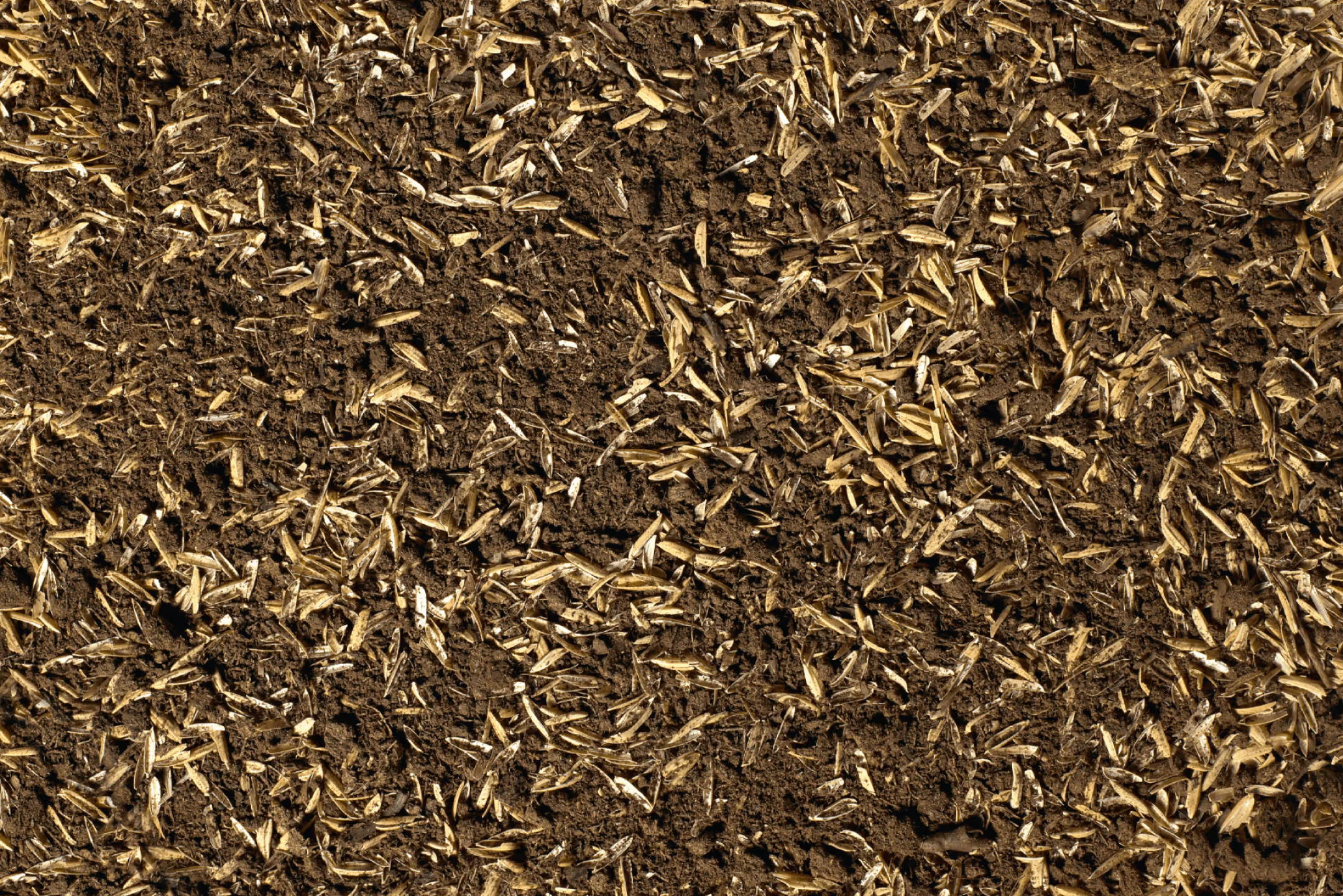
Closeup of PBH Nature's Media Amendment.
|
Salvia root growth in 72% Sphagnum peat with 28% PBH, shown six weeks after transplant from plug tray.
|
Lucas Greenhouses
Joe Moore, head grower for Lucas Greenhouses, opted to try PBH because he liked the fact that it was a natural by-product. In doing so, he discovered numerous other benefits, including a lower input cost.
"We decided to trial PBH initially because it is a renewable resource and a natural by-product. An added bonus was the fact that it is relatively dust free in the soil mixing process, especially when compared to perlite. Both of these things are very important to us. During the trials, we produced crops that were every bit as good as what we had been growing or even slightly better. For these reasons, we now use PBH in all our spring bedding plants, fall crops and our 6" poinsettias. We are seeing very high quality plants and saving roughly $4 per yard of mix versus perlite. That includes the cost of freight form Arkansas to New Jersey."
Joe Moore
Head Grower
Lucas Greenhouses
Monroeville, NJ
Fahr Greenhouses
Patrick Bellrose, president of Fahr Greenhouses, converted his entire operation to PBH after trying the product and quickly realizing its many benefits. The list of advantages he cites include lower cost, lack of Pythium, better root development, less dust and sustainability.
"We tried composted rice hulls several years back, but with poor results. Then I heard Dr. Evans from the University of Arkansas speak and decided to try the PBH product. I received a sample in 2005 and by May 2006 we were 100% PBH instead of perlite. Many things attracted me to it. Cost was one, but beyond that was root development and the total lack of Pythium even in our Vinca crop. We also like PBH because it is a natural product and we can promote its sustainability. Another real advantage is the lack of dust when mixing."
Patrick Bellrose
President
Fahr Greenhouses
Wildwood, MO
Pork and Plants Greenhouse
Eric Kreidermacher, the owner of Pork and Plants Greenhouse in Altura, Minnesota, finds PBH Nature's Media
Amendment the perfect amendment for his coir-based mix. The nursery grows all of its own plant material and sells primarily to a retail market.
"We are always looking for new and better and we like the idea of being totally natural. PBH is a very accessible natural product that is weed free and easy to use. Perlite particles are fine and dusty, which can be a real nuisance. There is none of that with PBH. We have done away with perlite and gone to PBH because it is easier to work with, less costly and gives us the porosity and drainage characteristics the plants need."
Eric Kreidermacher
Owner
Pork and Plants Greenhouse
Altura, MN
Ernst Conservation Seeds
Melinda Rudd, who manages greenhouse production for Ernst Conservation Seeds in Meadville, Pennsylvania, opted to try PBH Nature's Media Amendment after attending a presentation by Mike Evans of the University of Arkansas at the 2005 OFA Short Course.
"What I like about PBH is that the rice hulls are a more natural media component. They are also more typical of the actual plant environment. We have also observed more rapid and vigorous development of root growth, root balls and root hairs. The root hairs are a good indicator that the plant will establish more quickly when planted."
Melinda Rudd
Greenhouse Manager
Ernst Conservation Seeds
Meadville, Pennsylvania
Michael R. Evans of the Department of Horticulture at the University of Arkansas researched the use of parboiled fresh rice hulls as an alternative to perlite in horticultural substrates and determined the following:
- Incorporation of parboiled rice hulls into Sphagnum peat-based substrates did not result in significant nitrogen tie-up.
- Parboiled fresh rice hulls were free of viable weed seed.
- When incorporated into Sphagnum peat-based substrates, parboiled fresh rice hulls did not negatively impact the chemical properties of the substrate.
- When incorporated into Sphagnum peat-based substrates, parboiled fresh rice hulls provided equivalent or higher levels of drainage and air-filled pore space than perlite. (See Table 1.)
- Root and shoot growth was similar for plants grown in Sphagnum peat-based substrates amended with equivalent amounts of perlite or parboiled fresh rice hulls.
|
|
|
|
|
|
|
|
|